
Endpoints
ISO-TP TX/RX pairs across the standard 11-bit range and the 29-bit range, with an optional exhaustive search.
Engine · Enumeration
Before you can secure an ECU, you need to know its full diagnostic surface. AutoST enumerates endpoints, sessions, services and data identifiers over UDS, and tells you which ones are risky.
In short
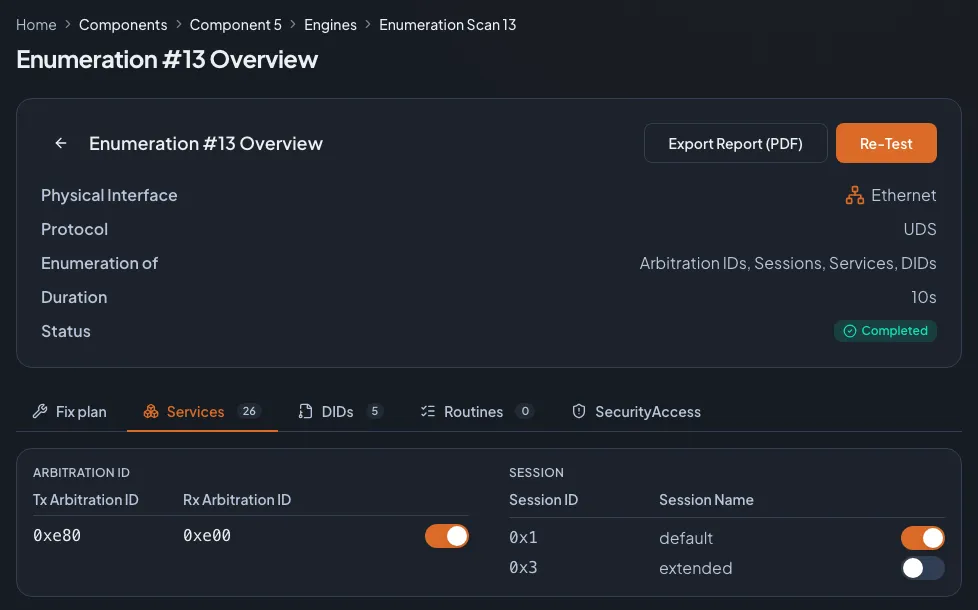
The enumeration engine is a non-destructive discovery scan over UDS (ISO 14229). It finds ISO-TP endpoints across the 11-bit and 29-bit ranges, discovers diagnostic sessions (0x10) including extended and programming, sweeps every service ID from 0x00 to 0xFE in each session and classifies the response, reads data identifiers (0x22, the 0xF180-0xF19F range by default or the full 0x0000-0xFFFF space), and discovers XCP and CCP calibration interfaces. Each risky service is scored against a configurable weighting.
What it does
AutoST probes the bus the way a specialist would, only exhaustively and in minutes.
What AutoST finds
ISO-TP TX/RX pairs across the standard 11-bit range and the 29-bit range, with an optional exhaustive search.
Default, extended and programming sessions, with robust entry and safe handling of ECUs that get stuck in programming.
Every SID probed and classified: supported, security-access denied, not supported in session, conditions not correct, or not supported.
Readable DIDs with their decoded values, either the identification range or the full identifier space.
Calibration interfaces exposed on CAN or CAN FD, a frequent and high-impact finding.
Risky services (ECU reset, routine control, memory access, request download) flagged and scored automatically.
FAQ
Enumeration is non-destructive: it discovers and reads, it does not write or fuzz. The programming session is tested last and can be skipped, because some ECUs get stuck in it.
It probes every service ID from 0x00 to 0xFE in each discovered session and classifies each one from its response code.
By default AutoST reads the identification DID range (0xF180-0xF19F). An exhaustive mode covers the full 0x0000-0xFFFF space, roughly ten minutes per session.
See it on your ECU
In one hour we scope a pilot: your bench, your protocols, the targets and what success looks like.

Your demo is withTom ZaubermannFounder of Zyberum, ex-lead of the VW InCar Security Testing Lab
Already trusted by Tier 1, Tier 2 suppliers and OEMs. References on request.
We reply within one business day.
Your privacy
We use cookies and similar technologies to measure our website and the success of our ads. You decide which ones we may use. You can change your choice at any time via "Cookie settings" in the footer. Privacy policy